I accidentally watched some breakfast TV on how hard it is not to be an overprotective parent. Should 12-year-olds be allowed alone on public transport? My brother used to go to school every day on a train without adult supervision from the age of 8, and I did the same from the age of 11. (It was the same train but obviously we didn't travel together.) Anyway, then I saw this on boing boing, and I think it's cool:
Wednesday, 28 April 2010

Tuesday, 27 April 2010
Recent books
Now that I no longer keep most of the books I read I like to have them on my blog so that I can look back on what I've read; but I keep forgetting to write them up. Here are five recent ones:
Mr Roberts, Alexei Sayle
This is a pretty short novel, more of a novella, which is a good thing because Alexei Sayle is a great short story writer. It's about an ex-pat Brit community in a Spanish valley. A teenage boy with a difficult young mother finds something odd crashed on a hill.
The Fire Gospel, Michel Faber
Another short one; not hugely substantial but quite entertaining. Reminded me a bit of Michael Frayn's Headlong in that someone finds something which they take advantage of in a naive way without seeing the terribly obvious pitfalls ahead. Frayn's character is actively unpleasant, though, while Faber's protagonist is just terminally hapless. I may have spent too long being a medievalist because I found the extracts from the discovered gospel far more interesting than the main character's travails in the book industry, and also the way that no one cares about its provenance annoyed me a bit.
The Luminous Life of Lilly Aphrodite, Beatrice Colin
A bit better than I was expecting -- the cover makes it look a bit too Richard and Judy -- I don't have anything against Richard and Judy choices per se but you can take it too far. It's sort of about film culture in Germany in the decades before the second world war, with a heroine who experiences things of the time without the plot being too predictable. Quite enjoyable but I'll surely never reread it.
Eight Faces at Three, Craig Rice
Slightly mad crime fiction written and set in 1930s Chicago. Craig Rice is the pseudonym of Georgiana Craig, who apparently had an over-the-top life, and wasn't especially happy. It's about a girl who wakes up to find her aunt stabbed, and every single clock in the house stopped at 3am, and is then the police's top suspect. The three detective characters spend a lot of time drinking and then having hangovers. I will read more of her stuff if I come across it, but probably won't try to search it out.
Traitor's Purse, Margery Allingham
Has there ever been a freakier or more sinister mystery writer than Margery Allingham? If you read one of her books you're not in the least guaranteed that the next one will be similar, unlike with Agatha Christie or Ellis Peters and such. I've read this one before, but had forgotten the plot. It starts with a man waking up under arrest in hospital with no memory of anything at all, but a conviction that something truly terrible is about to happen associated with the number 15, and that he is the only person who can stop it. He manages to escape from hospital with the help of a woman he thinks is his wife. Good stuff.
Mr Roberts, Alexei Sayle
This is a pretty short novel, more of a novella, which is a good thing because Alexei Sayle is a great short story writer. It's about an ex-pat Brit community in a Spanish valley. A teenage boy with a difficult young mother finds something odd crashed on a hill.
The Fire Gospel, Michel Faber
Another short one; not hugely substantial but quite entertaining. Reminded me a bit of Michael Frayn's Headlong in that someone finds something which they take advantage of in a naive way without seeing the terribly obvious pitfalls ahead. Frayn's character is actively unpleasant, though, while Faber's protagonist is just terminally hapless. I may have spent too long being a medievalist because I found the extracts from the discovered gospel far more interesting than the main character's travails in the book industry, and also the way that no one cares about its provenance annoyed me a bit.
The Luminous Life of Lilly Aphrodite, Beatrice Colin
A bit better than I was expecting -- the cover makes it look a bit too Richard and Judy -- I don't have anything against Richard and Judy choices per se but you can take it too far. It's sort of about film culture in Germany in the decades before the second world war, with a heroine who experiences things of the time without the plot being too predictable. Quite enjoyable but I'll surely never reread it.
Eight Faces at Three, Craig Rice
Slightly mad crime fiction written and set in 1930s Chicago. Craig Rice is the pseudonym of Georgiana Craig, who apparently had an over-the-top life, and wasn't especially happy. It's about a girl who wakes up to find her aunt stabbed, and every single clock in the house stopped at 3am, and is then the police's top suspect. The three detective characters spend a lot of time drinking and then having hangovers. I will read more of her stuff if I come across it, but probably won't try to search it out.
Traitor's Purse, Margery Allingham
Has there ever been a freakier or more sinister mystery writer than Margery Allingham? If you read one of her books you're not in the least guaranteed that the next one will be similar, unlike with Agatha Christie or Ellis Peters and such. I've read this one before, but had forgotten the plot. It starts with a man waking up under arrest in hospital with no memory of anything at all, but a conviction that something truly terrible is about to happen associated with the number 15, and that he is the only person who can stop it. He manages to escape from hospital with the help of a woman he thinks is his wife. Good stuff.
Saturday, 24 April 2010
What the internet sells
I wish jeans would return to the high-waisted look of my childhood. In the meantime here are some useful stickers which many people could employ:
Des stickers pour cacher la raie de vos fesses
This is Spinal Tape -- perhaps it could be put to the same use. (That site also sells synthetic owl puke, which is a bit of a cop-out compared with combing forests looking for real owl pellets like my brother and I did when we were small -- we had our own little natural history museum -- but on the other hand Mum wouldn't let us touch them if they were growing mould, and they usually were, so this way might be less disappointing. I wonder what happened to our museum? It had some good skulls in it.)
I'd quite like a Salvador Dali moustaches watch, because it gives me joy, but would the joy wear off? Consumerism isn't as straightforward as you'd think.
When small nephew is a bit older I think I might get him some Mad Scientist Alphabet Blocks. They look beautifully made. For myself, I would like a spy coin. Or better still lots of spy coins! I would release them into the wild and no one would notice they had a spy coin until it was rejected by the UL photocopying card charger, and then they'd look carefully and unscrew it, and inside I would put a small note saying "Hello!" Or something better, like a piece of microfilm, or a mini SD card, probably containing an advert for cheap Ciali$.
Edit: I also want a wooden hard drive.
Des stickers pour cacher la raie de vos fesses
This is Spinal Tape -- perhaps it could be put to the same use. (That site also sells synthetic owl puke, which is a bit of a cop-out compared with combing forests looking for real owl pellets like my brother and I did when we were small -- we had our own little natural history museum -- but on the other hand Mum wouldn't let us touch them if they were growing mould, and they usually were, so this way might be less disappointing. I wonder what happened to our museum? It had some good skulls in it.)
I'd quite like a Salvador Dali moustaches watch, because it gives me joy, but would the joy wear off? Consumerism isn't as straightforward as you'd think.
When small nephew is a bit older I think I might get him some Mad Scientist Alphabet Blocks. They look beautifully made. For myself, I would like a spy coin. Or better still lots of spy coins! I would release them into the wild and no one would notice they had a spy coin until it was rejected by the UL photocopying card charger, and then they'd look carefully and unscrew it, and inside I would put a small note saying "Hello!" Or something better, like a piece of microfilm, or a mini SD card, probably containing an advert for cheap Ciali$.
Edit: I also want a wooden hard drive.
Friday, 23 April 2010
Juniper learns to walk
Here are a few brief bits of Juniper the alpaca cria's first hour.
1. She's only about twenty-five minutes old and her ears are still wet, but she's beginning to think she ought to try standing up. The noises are Devon spring insects and birds, small nephew, and me.
2. She's walking! sort of. She may be staggering in a drunken manner, but stop and consider that about forty minutes earlier she was all folded up and actually inside the alpaca behind her.
3. She's got the hang of legs! And she came up onto the lawn to say hello to us. Gracie is the mother, and Gypsy and Gwarakusi are the other two adults, both of whom should be having their own cria within a month. Gypsy is the one who says "meep" at me.
Not long after this Gracie dropped the afterbirth right in front of us as we were trying to eat icecream.
1. She's only about twenty-five minutes old and her ears are still wet, but she's beginning to think she ought to try standing up. The noises are Devon spring insects and birds, small nephew, and me.
2. She's walking! sort of. She may be staggering in a drunken manner, but stop and consider that about forty minutes earlier she was all folded up and actually inside the alpaca behind her.
3. She's got the hang of legs! And she came up onto the lawn to say hello to us. Gracie is the mother, and Gypsy and Gwarakusi are the other two adults, both of whom should be having their own cria within a month. Gypsy is the one who says "meep" at me.
Not long after this Gracie dropped the afterbirth right in front of us as we were trying to eat icecream.
More Juniper
OK so I'm not great at this liveblogging thing. Here are some pictures of Juniper with her mother Gracie in her first half an hour or so:

Her legs are ridiculously long and not easy to manage:

All baby alpacas get the hang of their back legs before the front legs, and at first they are prone to collapsing in somersaults.

Hurray! She's managed to stand up, albeit in an odd pose. Still it only took her thirty-five to forty minutes.


Her legs are ridiculously long and not easy to manage:

All baby alpacas get the hang of their back legs before the front legs, and at first they are prone to collapsing in somersaults.

Hurray! She's managed to stand up, albeit in an odd pose. Still it only took her thirty-five to forty minutes.

Juniper
Live-blogging experiment interrupted by grumpiness of nephew. Baby Juniper (f) born circa 13.25. Currently being licked and encouraged by her mother, and just starting to try to stand up. On the one hand it's fun to watch them at this stage -- they're usually on their feet within an hour -- on the other hand if I hang around I may have to watch the afterbirth coming out, which very very far from a pretty sight. The crows are already gathering.
Exciting live blog action!
Gracie the alpaca has gone into labour in the paddock outside my window! She's waving her tail and looking a bit bewildered. I will post news of what someone, I forget who, aptly described as "a disgusting miracle", as it occurs. If you're unlucky I might even procure pictures.
Tuesday, 20 April 2010
Various odds and ends
The ongoing "evolutionary psychology" advice page at the Guardian is supposed to be funny, I imagine, but just gets increasingly offensive. This one suggests that this man's girlfriend dropped him once she realised he wasn't dominant in office politics, and as a nice sideline points out that men in "Eastern and African societies" behave like chimpanzees. Is there any evolutionary psychology at all which isn't just utter bullshit?
Geoffrey Hill, often seen at Corpus high table for lunch as the guest of a retired bishop, at least back when I used to be there, resulting in some awkward conversations where I realised I was totally incapable of saying anything intelligent about his poetry despite the fact that I hugely admire it, is top runner for the Oxford poetry professorship.
Dramatic pictures of the Iceland volcano thing. And at the opposite scale insects with dew drops on them -- very beautiful. Also pictures from inside waves.
Rats can do the Prisoner's Dilemma, apparently. I love my little rats. However I do dislike very much game theory. Here is an interesting one about a game show where you can win up to a million dollars by picking a sum you want, as long as at least one other person has asked for more than you, and no one has asked for less. I played this at Christmas with my family as an experiment, and my mother asked for one dollar, scuppering anyone's chances of getting any (purely theoretical) cash, on the grounds that she loves us all dearly and thinks that lots of money would be bad for our characters.
William Gibson says sensible things about writer's block. David Mitchell says sensible things about pole-dancing students at the Cambridge Union. And here is some Italo disco (yay!):
Geoffrey Hill, often seen at Corpus high table for lunch as the guest of a retired bishop, at least back when I used to be there, resulting in some awkward conversations where I realised I was totally incapable of saying anything intelligent about his poetry despite the fact that I hugely admire it, is top runner for the Oxford poetry professorship.
Dramatic pictures of the Iceland volcano thing. And at the opposite scale insects with dew drops on them -- very beautiful. Also pictures from inside waves.
Rats can do the Prisoner's Dilemma, apparently. I love my little rats. However I do dislike very much game theory. Here is an interesting one about a game show where you can win up to a million dollars by picking a sum you want, as long as at least one other person has asked for more than you, and no one has asked for less. I played this at Christmas with my family as an experiment, and my mother asked for one dollar, scuppering anyone's chances of getting any (purely theoretical) cash, on the grounds that she loves us all dearly and thinks that lots of money would be bad for our characters.
William Gibson says sensible things about writer's block. David Mitchell says sensible things about pole-dancing students at the Cambridge Union. And here is some Italo disco (yay!):
Friday, 16 April 2010
A debate about politics
I can't think of anything more depressing than watching the party leaders' live debates. Now I am watching breakfast TV on BBC1 and some analysts are discussing it in a way which rams home why the whole thing was a very bad idea. For example, they were quite struck by the gradations of colour of the three candidates' suits and shirts. I offer up their comments as an aid to voters who are trying to weigh up the difference between the options on offer:
Nick Clegg must take his hand out of his pocket.
Gordon Brown has an overly mobile jaw.
David Cameron has strong hand gestures but should have looked at the camera more.
So there you are. The other piece of analysis I have heard was late last night in the sitting room of the guest house where I'm staying. A bloke who is staying here watched the whole thing. I don't know where he's from but he has a very strong Eastern European accent. His comment was:
I watch debate. This David Cameron, he is a jerk.
Nick Clegg must take his hand out of his pocket.
Gordon Brown has an overly mobile jaw.
David Cameron has strong hand gestures but should have looked at the camera more.
So there you are. The other piece of analysis I have heard was late last night in the sitting room of the guest house where I'm staying. A bloke who is staying here watched the whole thing. I don't know where he's from but he has a very strong Eastern European accent. His comment was:
I watch debate. This David Cameron, he is a jerk.
Wednesday, 31 March 2010
Short post about good internet stuff
I just discovered the Tiny Art Director:
http://tinyartdirector.blogspot.com/
A professional artist takes commissions from his small daughter and reports her response to the finished work. Best read chronologically, starting when she was 2 years old. My favourite of her comments is the crushing "You're doing art the wrong way".
I hated Mika at first, but "Relax" was quite good. And here is his new one, which is excellent. RedOne has done pretty well out of the whole Lady Gaga thing, and without having to go to the trouble of wearing odd clothes and leaping about a lot.
There's this new thing called mflow, which is a bit like twitter if twitter were nothing but music recommendations (which would obviously be an improvement). You can listen to whole versions of recommended songs, but only once; it's more about finding new stuff than a method of actually listening to your music. I quite like it but goodness knows whether it will last -- the internet is so tiring these days. I got an invite off of the popjustice website (where else). (Also I have invitations now if anyone wants one.) It reminded me of this wonderful and oddly sinister song. According to wikipedia it was the last ABBA song ever recorded, and Agnetha sang the lyrics with the lights off.
So I bought it. By my calculations this means I have given popjustice 20p. And I'm fine with that.
You can get 4OD on Youtube now. I'm trying to work out how to link a computer up to my parents' TV. I wish I were just a bit more geeky; I'm geeky enough to have most of the disadvantages without the advantage of being able to do Cool Stuff.
Also I would like to point out that the new Mr Kipling advert, in which a slightly disconsolate Mrs Kipling implies that his renowned ability with cakes is a way of coping with erectile dysfunction, is wrong. Just plain wrong.
http://tinyartdirector.blogspot.com/
A professional artist takes commissions from his small daughter and reports her response to the finished work. Best read chronologically, starting when she was 2 years old. My favourite of her comments is the crushing "You're doing art the wrong way".
I hated Mika at first, but "Relax" was quite good. And here is his new one, which is excellent. RedOne has done pretty well out of the whole Lady Gaga thing, and without having to go to the trouble of wearing odd clothes and leaping about a lot.
There's this new thing called mflow, which is a bit like twitter if twitter were nothing but music recommendations (which would obviously be an improvement). You can listen to whole versions of recommended songs, but only once; it's more about finding new stuff than a method of actually listening to your music. I quite like it but goodness knows whether it will last -- the internet is so tiring these days. I got an invite off of the popjustice website (where else). (Also I have invitations now if anyone wants one.) It reminded me of this wonderful and oddly sinister song. According to wikipedia it was the last ABBA song ever recorded, and Agnetha sang the lyrics with the lights off.
So I bought it. By my calculations this means I have given popjustice 20p. And I'm fine with that.
You can get 4OD on Youtube now. I'm trying to work out how to link a computer up to my parents' TV. I wish I were just a bit more geeky; I'm geeky enough to have most of the disadvantages without the advantage of being able to do Cool Stuff.
Also I would like to point out that the new Mr Kipling advert, in which a slightly disconsolate Mrs Kipling implies that his renowned ability with cakes is a way of coping with erectile dysfunction, is wrong. Just plain wrong.
Tuesday, 30 March 2010
Organization
Paper is good stuff. Hurray for paper! On the other hand, it weighs quite a lot and takes up space. Also a big heap of paper is hard to manage in the long term, unless you are excellent at filing. Plus can I take all my files with me into a manuscript library? No, I cannot. But I can take this: [stock photo]

It's my little 500Gb hard drive! (If you want one you can get a commemorative "Michael Jackson is dead" version for less money than the plain variety.) I am quite pleased with how I'm getting on with making this change, so I thought I'd write a blog post about it, partly as an exercise in self-satisfaction, but also just in case anyone reading wants to make a similar transition. Of course the stuff I work on imposes a few odd constraints on how I work.
1. Managing references.
A long time ago I got fed up of retyping the same bibliographical references, and made a file called "Megabibliography" which was just an amalgamation of all the bibliographies I had ever written, for reference purposes. They were in variable styles, of course, but it worked as a quickish way of getting references. I switched to Endnote in 2003 or 4 when the whole thing got out of hand, and I had a several-thousand-item bibliography I had to manage for work, and also needed to generate an annual bibliography in a very odd style. (Importing all the data gave me RSI.)
The things which Endnote does which I really need are: ability to tag documents with keywords (e.g. "Calendars", "ASE 2006", or "ASE check", etc); easily customisable export styles, allowing me to produce my own style sheets for obscure journals, and XML material for easy import into other things; and it quickly generates citations in a way which I can edit. The last is vital: most reference software is designed for scientists, and is based on the idea that your computer does all the work for you. But in the humanities a reference manager is essentially a time-saving device. It won't be able to cope with certain oddities, like nineteenth-century German monographs which are also issues of a journal, etc, and it's important that you can easily edit what comes out. Beware of Zotero and Mendeley. They may be OK if you're just starting out, and they are free, but they do things automatically for you which you don't necessarily want done, and are very inflexible. Also I am intensely suspicious of the cloud. It's just not true that I am rarely offline; sometimes I'm on a train, or in Corpus Christi College, where there is no wifi at all. Occasionally broadband connections go down. And I'm not a fan of their social-networking-style features. The other day Mendeley told me that the most popular author in the Humanities is Foucault, and suggested that I might like to read Foucault. As many as 15 Mendeley users have Foucault in their bibliographies, apparently. Stupid software. That sort of thing is a bit like the Ask the Audience option on Who Wants To Be A Millionaire, in that it's most useful for the questions about soap operas. I can quite happily believe I'll discover a fun YouTube clip or a good TV show through Web 2.0/Cloud-style stuff; not so sure I'm going to find help in my work on late Anglo-Saxon liturgy.
Be cautious also about the option to import references automatically into your library. One of those applications' website says something like "Avoid typing errors by importing references from web databases" but what it means is "Propagate other people's errors by importing references from web databases". Library catalogues are packed with mistakes, because a lot of libraries mistakenly treat cataloguing as a data-entry task and pay casual staff not much money to do it. Import material as a time saver, but you'll need to edit it before moving on.
2. Recycling my "Photocopied Papers" folders.
All my folders of photocopied papers have now been recycled into rat bedding or taken away by the council, and I gave the lever arch files to my dad. The key to this was a small sheet-feeding scanner, and DVD box sets. The DVD box sets are vital because this is dull work in the same way that feeding CDs into iTunes is dull. I recommend the complete Seinfeld; it's light-hearted and you've probably seen them all before anyway. I bought a little scanner which does one sheet at a time quite quickly and feeds it through for you. Plus points: it's cheap; it's very portable; it came with excellent software. It was probably my favourite thing about 2009. (It wasn't a great year.) But if I were seriously rich I would have spent about 300 quid on this superfast non-portable sheet-feeding scanner which can do double-sided. Really it's the software which made the whole thing possible. Feeding paper into a scanner is fine because you don't need to think about it. Then, once I had done a whole article, I simply highlighted all the images from it in Presto PageManager, which came with the scanner, right-clicked to stack them, and then dragged them onto a PDF icon to save as a multi-page PDF. Whilst doing this I was beginning to feed the next article through (unless I had got too distracted by the antics of that Kramer). So if you have a scanner but no software then look into something which will painlessly turn images into pdfs for you.
3. Metamanuscripts.
I work on medieval manuscripts. I pay a lot of attention to form as well as content. I have not yet managed to find a way of taking notes on a computer which is better for my work than paper and pencil, because I need sometimes to make drawings of odd shapes of letters, or of decoration. I'm not an artist by a long long way but I can copy things OKish. I've tried using electronic pen input, with a graphics tablet, but it's not as controllable as a real pencil in terms of shading and such like; and some libraries let you take your own photographs, but not all do, and besides sometimes you need to copy something in order to look at it properly, or to add notes on things you can't expect to come out in a photograph, like words scratched into gold on initials. So I have a lot of manuscripts about manuscripts. I digitised them in the same way as the articles of step 2, but I haven't recycled them just in case, since they are unique; the originals sit in a couple of large boxes full of suspension files. I have added the PDFs to my MS-image files, and now if I'm sitting in a library looking at a manuscript and it reminds me of another manuscript I can immediately call up all my notes on it and any images I have just like that. This is an immensely useful tool for me. I continue to take notes with a pencil on paper, and then scan them in when I get home.
NB The graphics tablet might not have worked for me for manuscript notes, but it was great for the RSI caused by step 1. Hurray! Also these gloves, without which I cannot now type; I recommend them heartily if you have back-of-the-hand style RSI like me, rather than bad wrists.
4. Photocopying costs 10p a sheet at CUL, and 20p at the BL (where you are not allowed to copy more than a single page at a time, e.g. no double-page spreads).
I ended up in a situation where I would carefully (and expensively) photocopy an article, take it home, scan it, and then put the paper straight into the recycling. My current project is an attempt to cut out the middle phase of this, thus saving money, time, and the planet. I have acquired a very cheap, portable, USB-powered flat-bed scanner, and I am experimenting with scanning things from books. For example I have some multi-author books with one or two seriously useful articles in, and I am trying out digitising these so that I can take them with me to libraries. So far it's working well. So if possible in future I will borrow books or journals and copy the article I want straight on to my computer, and the portable scanner can live in my suitcase when I travel. Now I know that the UL photocopiers will now, theoretically, scan things for you and e-mail them to you for 8p (!) an image, but when I tried it it charged me for a whole article and only sent me the first page. Meaning I had to go back to the library and find the journal again, etc. I might give this another go sometime though, for things I can't borrow.
5. Image and text
I didn't originally OCR my scans. This was because at work I used to have access to the full copy of Adobe Acrobat, which would OCR pdfs for you, but very very slowly, without much accuracy, and with a large augmentation to the storage size of the file, so I wrote it off as a concept. However, I have recently got hold of ABBY Finereader 10 and it is very fine indeed. It even OCRs in Latin. If I run pdfs through it which I scanned in from photocopies of open books, so that they have two pages side by side on a landscape sheet of A4, it automatically splits these into two separate pages and rotates them before doing the OCR. It's also possible to scan straight into Finereader; it does a lot of image processing though, and I think it's quicker to give it pdfs which it doesn't feel the need to tidy up so much.
6. Managing PDFs.
The point of having a computer-read text is to be able to search it. Of course the OCR isn't perfect (though it's very good) and I'm not wasting time making it perfect, so searches have to be reasonably fuzzy. It's at this point that I'm still experimenting. I can set Windows' own indexing facility to include pdfs (using the pdf iFilter which comes with Windows 7 at least) and then I can look for, say, "Harley" in all pdfs in a folder, and it returns a list of matches. However, it doesn't give me context -- it would be useful to have the several words before and after, especially since I am probably most interested in the number that follows Harley. Or I can use the "search all in folder" option in Adobe Reader 9, which I think will be useful. Ideally I'd like to produce a concordance file, but concordance software seems on the whole to need .txt files. If I could find a good piece of software that allowed me to insert my own index tags in pdfs and then produce an index across many pdf files I would have a go at making manuscript indexes for myself. These would be very very useful. I have manually indexed important articles in the past, and it's tedious work, but wonderful to have later.
7. Backing up.
I had a hard drive fail only the other day, but my complex backup system meant that I didn't lose any data. Get at least one large external hard drive and set things backing up when you go to bed. I use BounceBack to do system backups and Allway Sync to do basic synchronisations of data. (BounceBack came free on an external hard drive I bought; it's sometimes worth paying attention to the software that comes bundled with hardware.) Allway Sync lets you choose whether or not things deleted from the source folder get deleted from the backup folder, so I back my external hard drive up twice, once in each way to different hard drives. If I accidentally delete something I can retrieve it from the comprehensive backup, but if I were to lose the whole drive I would get my new copy from the more accurate backup. Of course if I were really paranoid I would have an off-site backup, but I have too much data for an online one.
8. What I'd like to try.
I think I'm going to try taking photos of books and see whether Finereader can OCR them for me. The problem will be camera shake. But ABBYY have a special application for this, Fotoreader, which is what gave me the idea it might be worth trying.
9. Maybe in about 10 years' time.
My graphics tablet has amazing handwriting recognition. I found I could write more or less normally and it would OCR what I had written. So the next thing will be something I can run my handwritten MS notes through which will OCR them and make them searchable. Not possible now I think, but technology might well head that way. So at present I can't search my manuscript notes, which would be a useful thing to be able to do. I have two workarounds for this: the first is Onenote. I switched to Onenote a couple of years ago and now I absolutely depend on it for all my work and home organisation and everything, and will never be able to leave it. It replaces those lever arch files I used to have which organised notes for a particular project. When I find something in a manuscript which I don't need at the moment but think I might want to find again one day I make a note in Onenote. For example the other day I saw an interesting form of quire signature which reminded me of something in a Trinity MS, and because I made a quick note in Onenote I can find it immediately by searching on "quire" and tell you now that it was in an 8th-century Merovingian manuscript in the Vatican. I'm not going to go into the excellences of Onenote now; but I find it very useful for many things, and it's now the core of how I work. My second workaround is old school: I have a little address book, the sort with alphabetical tabs but no actual text printed in it, and I copy interesting letterforms into it. One day I'll work out how to migrate it to my computer, but at the moment I just carry that around. It's useful to consult but easy to leave it home accidentally.
10. If I were a proper geek.
There are instructables and such online for making your own book scanner, from complex ones to more basic but clever designs. It would be a lot quicker, and a bit better for the book, than using a flat-bed scanner or photocopier, and quicker and more accurate than the basic camera method. But I don't have the oomph to make one, and even if I did it would be a bit expensive. You can get a proper professional set up for about 1500 dollars, plus the cost of a good camera, and I think more and more libraries are investing in them. Then they digitise books which are in demand for undergraduates. I have no idea what the copyright implications of that are. (For myself I'm not digitising anything I'm not allowed to photocopy, so I don't think it's an issue for me.) I saw the scanner at Stanford when I went out, one of the ones which works for google books, but it's huge, the size of a room, and we've all seen how patchy its results are.
Of course some parts of this have taken me quite a bit of time, but I am prone to intense but short-lived enthusiasms, and got most of it done while watching TV I was probably going to watch anyway. Now it seems easier to me to scan something in than to file it. And the wierd thing is that my pdf library is only just over 9Gb in size, e.g. tiny. (My manuscript notes library is 155Gb but then it has a lot of images in.)

It's my little 500Gb hard drive! (If you want one you can get a commemorative "Michael Jackson is dead" version for less money than the plain variety.) I am quite pleased with how I'm getting on with making this change, so I thought I'd write a blog post about it, partly as an exercise in self-satisfaction, but also just in case anyone reading wants to make a similar transition. Of course the stuff I work on imposes a few odd constraints on how I work.
1. Managing references.
A long time ago I got fed up of retyping the same bibliographical references, and made a file called "Megabibliography" which was just an amalgamation of all the bibliographies I had ever written, for reference purposes. They were in variable styles, of course, but it worked as a quickish way of getting references. I switched to Endnote in 2003 or 4 when the whole thing got out of hand, and I had a several-thousand-item bibliography I had to manage for work, and also needed to generate an annual bibliography in a very odd style. (Importing all the data gave me RSI.)
The things which Endnote does which I really need are: ability to tag documents with keywords (e.g. "Calendars", "ASE 2006", or "ASE check", etc); easily customisable export styles, allowing me to produce my own style sheets for obscure journals, and XML material for easy import into other things; and it quickly generates citations in a way which I can edit. The last is vital: most reference software is designed for scientists, and is based on the idea that your computer does all the work for you. But in the humanities a reference manager is essentially a time-saving device. It won't be able to cope with certain oddities, like nineteenth-century German monographs which are also issues of a journal, etc, and it's important that you can easily edit what comes out. Beware of Zotero and Mendeley. They may be OK if you're just starting out, and they are free, but they do things automatically for you which you don't necessarily want done, and are very inflexible. Also I am intensely suspicious of the cloud. It's just not true that I am rarely offline; sometimes I'm on a train, or in Corpus Christi College, where there is no wifi at all. Occasionally broadband connections go down. And I'm not a fan of their social-networking-style features. The other day Mendeley told me that the most popular author in the Humanities is Foucault, and suggested that I might like to read Foucault. As many as 15 Mendeley users have Foucault in their bibliographies, apparently. Stupid software. That sort of thing is a bit like the Ask the Audience option on Who Wants To Be A Millionaire, in that it's most useful for the questions about soap operas. I can quite happily believe I'll discover a fun YouTube clip or a good TV show through Web 2.0/Cloud-style stuff; not so sure I'm going to find help in my work on late Anglo-Saxon liturgy.
Be cautious also about the option to import references automatically into your library. One of those applications' website says something like "Avoid typing errors by importing references from web databases" but what it means is "Propagate other people's errors by importing references from web databases". Library catalogues are packed with mistakes, because a lot of libraries mistakenly treat cataloguing as a data-entry task and pay casual staff not much money to do it. Import material as a time saver, but you'll need to edit it before moving on.
2. Recycling my "Photocopied Papers" folders.
All my folders of photocopied papers have now been recycled into rat bedding or taken away by the council, and I gave the lever arch files to my dad. The key to this was a small sheet-feeding scanner, and DVD box sets. The DVD box sets are vital because this is dull work in the same way that feeding CDs into iTunes is dull. I recommend the complete Seinfeld; it's light-hearted and you've probably seen them all before anyway. I bought a little scanner which does one sheet at a time quite quickly and feeds it through for you. Plus points: it's cheap; it's very portable; it came with excellent software. It was probably my favourite thing about 2009. (It wasn't a great year.) But if I were seriously rich I would have spent about 300 quid on this superfast non-portable sheet-feeding scanner which can do double-sided. Really it's the software which made the whole thing possible. Feeding paper into a scanner is fine because you don't need to think about it. Then, once I had done a whole article, I simply highlighted all the images from it in Presto PageManager, which came with the scanner, right-clicked to stack them, and then dragged them onto a PDF icon to save as a multi-page PDF. Whilst doing this I was beginning to feed the next article through (unless I had got too distracted by the antics of that Kramer). So if you have a scanner but no software then look into something which will painlessly turn images into pdfs for you.
3. Metamanuscripts.
I work on medieval manuscripts. I pay a lot of attention to form as well as content. I have not yet managed to find a way of taking notes on a computer which is better for my work than paper and pencil, because I need sometimes to make drawings of odd shapes of letters, or of decoration. I'm not an artist by a long long way but I can copy things OKish. I've tried using electronic pen input, with a graphics tablet, but it's not as controllable as a real pencil in terms of shading and such like; and some libraries let you take your own photographs, but not all do, and besides sometimes you need to copy something in order to look at it properly, or to add notes on things you can't expect to come out in a photograph, like words scratched into gold on initials. So I have a lot of manuscripts about manuscripts. I digitised them in the same way as the articles of step 2, but I haven't recycled them just in case, since they are unique; the originals sit in a couple of large boxes full of suspension files. I have added the PDFs to my MS-image files, and now if I'm sitting in a library looking at a manuscript and it reminds me of another manuscript I can immediately call up all my notes on it and any images I have just like that. This is an immensely useful tool for me. I continue to take notes with a pencil on paper, and then scan them in when I get home.
NB The graphics tablet might not have worked for me for manuscript notes, but it was great for the RSI caused by step 1. Hurray! Also these gloves, without which I cannot now type; I recommend them heartily if you have back-of-the-hand style RSI like me, rather than bad wrists.
4. Photocopying costs 10p a sheet at CUL, and 20p at the BL (where you are not allowed to copy more than a single page at a time, e.g. no double-page spreads).
I ended up in a situation where I would carefully (and expensively) photocopy an article, take it home, scan it, and then put the paper straight into the recycling. My current project is an attempt to cut out the middle phase of this, thus saving money, time, and the planet. I have acquired a very cheap, portable, USB-powered flat-bed scanner, and I am experimenting with scanning things from books. For example I have some multi-author books with one or two seriously useful articles in, and I am trying out digitising these so that I can take them with me to libraries. So far it's working well. So if possible in future I will borrow books or journals and copy the article I want straight on to my computer, and the portable scanner can live in my suitcase when I travel. Now I know that the UL photocopiers will now, theoretically, scan things for you and e-mail them to you for 8p (!) an image, but when I tried it it charged me for a whole article and only sent me the first page. Meaning I had to go back to the library and find the journal again, etc. I might give this another go sometime though, for things I can't borrow.
5. Image and text
I didn't originally OCR my scans. This was because at work I used to have access to the full copy of Adobe Acrobat, which would OCR pdfs for you, but very very slowly, without much accuracy, and with a large augmentation to the storage size of the file, so I wrote it off as a concept. However, I have recently got hold of ABBY Finereader 10 and it is very fine indeed. It even OCRs in Latin. If I run pdfs through it which I scanned in from photocopies of open books, so that they have two pages side by side on a landscape sheet of A4, it automatically splits these into two separate pages and rotates them before doing the OCR. It's also possible to scan straight into Finereader; it does a lot of image processing though, and I think it's quicker to give it pdfs which it doesn't feel the need to tidy up so much.
6. Managing PDFs.
The point of having a computer-read text is to be able to search it. Of course the OCR isn't perfect (though it's very good) and I'm not wasting time making it perfect, so searches have to be reasonably fuzzy. It's at this point that I'm still experimenting. I can set Windows' own indexing facility to include pdfs (using the pdf iFilter which comes with Windows 7 at least) and then I can look for, say, "Harley" in all pdfs in a folder, and it returns a list of matches. However, it doesn't give me context -- it would be useful to have the several words before and after, especially since I am probably most interested in the number that follows Harley. Or I can use the "search all in folder" option in Adobe Reader 9, which I think will be useful. Ideally I'd like to produce a concordance file, but concordance software seems on the whole to need .txt files. If I could find a good piece of software that allowed me to insert my own index tags in pdfs and then produce an index across many pdf files I would have a go at making manuscript indexes for myself. These would be very very useful. I have manually indexed important articles in the past, and it's tedious work, but wonderful to have later.
7. Backing up.
I had a hard drive fail only the other day, but my complex backup system meant that I didn't lose any data. Get at least one large external hard drive and set things backing up when you go to bed. I use BounceBack to do system backups and Allway Sync to do basic synchronisations of data. (BounceBack came free on an external hard drive I bought; it's sometimes worth paying attention to the software that comes bundled with hardware.) Allway Sync lets you choose whether or not things deleted from the source folder get deleted from the backup folder, so I back my external hard drive up twice, once in each way to different hard drives. If I accidentally delete something I can retrieve it from the comprehensive backup, but if I were to lose the whole drive I would get my new copy from the more accurate backup. Of course if I were really paranoid I would have an off-site backup, but I have too much data for an online one.
8. What I'd like to try.
I think I'm going to try taking photos of books and see whether Finereader can OCR them for me. The problem will be camera shake. But ABBYY have a special application for this, Fotoreader, which is what gave me the idea it might be worth trying.
9. Maybe in about 10 years' time.
My graphics tablet has amazing handwriting recognition. I found I could write more or less normally and it would OCR what I had written. So the next thing will be something I can run my handwritten MS notes through which will OCR them and make them searchable. Not possible now I think, but technology might well head that way. So at present I can't search my manuscript notes, which would be a useful thing to be able to do. I have two workarounds for this: the first is Onenote. I switched to Onenote a couple of years ago and now I absolutely depend on it for all my work and home organisation and everything, and will never be able to leave it. It replaces those lever arch files I used to have which organised notes for a particular project. When I find something in a manuscript which I don't need at the moment but think I might want to find again one day I make a note in Onenote. For example the other day I saw an interesting form of quire signature which reminded me of something in a Trinity MS, and because I made a quick note in Onenote I can find it immediately by searching on "quire" and tell you now that it was in an 8th-century Merovingian manuscript in the Vatican. I'm not going to go into the excellences of Onenote now; but I find it very useful for many things, and it's now the core of how I work. My second workaround is old school: I have a little address book, the sort with alphabetical tabs but no actual text printed in it, and I copy interesting letterforms into it. One day I'll work out how to migrate it to my computer, but at the moment I just carry that around. It's useful to consult but easy to leave it home accidentally.
10. If I were a proper geek.
There are instructables and such online for making your own book scanner, from complex ones to more basic but clever designs. It would be a lot quicker, and a bit better for the book, than using a flat-bed scanner or photocopier, and quicker and more accurate than the basic camera method. But I don't have the oomph to make one, and even if I did it would be a bit expensive. You can get a proper professional set up for about 1500 dollars, plus the cost of a good camera, and I think more and more libraries are investing in them. Then they digitise books which are in demand for undergraduates. I have no idea what the copyright implications of that are. (For myself I'm not digitising anything I'm not allowed to photocopy, so I don't think it's an issue for me.) I saw the scanner at Stanford when I went out, one of the ones which works for google books, but it's huge, the size of a room, and we've all seen how patchy its results are.
Of course some parts of this have taken me quite a bit of time, but I am prone to intense but short-lived enthusiasms, and got most of it done while watching TV I was probably going to watch anyway. Now it seems easier to me to scan something in than to file it. And the wierd thing is that my pdf library is only just over 9Gb in size, e.g. tiny. (My manuscript notes library is 155Gb but then it has a lot of images in.)
Wednesday, 24 March 2010
Uncanny voices
This is my blog, and I'll fill it with embedded YouTube videos if I want to. In more news from the internet of the recent past, here is a recentish Hot Chip video. Now, I was feeling a bit, as it were, "over" Hot Chip, but I've decided I like them again on the strength of this. Well done Peter Serafinowicz! It does exactly what a video should do: make you listen to the song enough that you get to like it; and draw out some quality of the song that you would have liked anyway. (In this case, the uncanniness of the man's voice.) It's a bit like the way that good literary criticism leaves you with a greater appreciation of the work itself. I never got Antony and Cleopatra when we did it for A-level until I read an excellent essay saying it was all about gaps in communication, but ever since then I've actually been quite fond of it as a play. (I think that's why I don't like a lot of Theory-style criticism much, because it adds too much. It's like if someone said, Look at that tree! and then pointed out to you some of the beautiful things about the tree, you could look at the tree and enjoy those things which you might not have noticed immediately; whereas lots of modern criticism is more about painting the tree in bright colours and hanging exciting things off its branches, and yes the result looks great and very interesting, but I'm more interested in the tree itself, and frankly I think you're a bit wierd.)
And in news from my ipod's shuffle facility, here is one of my favourite Handel arias. My version is sung by Sarah Connolly, who is truly brilliant, and takes it a bit more slowly, which I think suits it better; but there's nothing so uncanny as a counter-tenor's voice. (Myself I'm still croaking from my endless sore throat *sigh of self-pity*.)
And in news from my ipod's shuffle facility, here is one of my favourite Handel arias. My version is sung by Sarah Connolly, who is truly brilliant, and takes it a bit more slowly, which I think suits it better; but there's nothing so uncanny as a counter-tenor's voice. (Myself I'm still croaking from my endless sore throat *sigh of self-pity*.)
Tuesday, 23 March 2010
It continues
New annoyances: thousand-pound council tax bill for a place I no longer live, necessitating lots of repeat phone calls to people who are terribly nice but say everything's fixed when it turns out later that it isn't; I can't find my copy of Bishop's English Caroline Minuscule (once owned by Clemoes); I still have a horrible sore throat and the only pastilles which help are foul; and frankly being involved in the castration of sweet little alpacas is revolting. Darcy the alpaca is very annoyed with us, and is taking it out on Glenfiddich, who is a bit more phlegmatic about the whole thing.
Continuing my catch-up with the internet of a fortnight ago, here is an excellent Sophie Ellis Bextor song which was new that recently:
And this excellent drawing blog has a guide to making perfect sauerkraut. Don't forget to put the wine in its place.
Continuing my catch-up with the internet of a fortnight ago, here is an excellent Sophie Ellis Bextor song which was new that recently:
And this excellent drawing blog has a guide to making perfect sauerkraut. Don't forget to put the wine in its place.
Sunday, 21 March 2010
Stuff
Well to add to the pile of life aggravations I now have a hard drive failure, a bad cold that's still going strong after three weeks, and failing to get a job I really wanted. Also an impending operation on my lovely rat Audrey. And tomorrow I get to help a vet castrate alpacas, which I'm not sure is going to be fun. I'm so far behind with my google reader subscriptions that it has just said "1000+" for ages. But while making vague attempts to break the 1000 barrier I was quite pleased to see this explanation of how Mega Shark can take out an aeroplane. Also I hadn't seen the clip before, and it is great:
I suspect that Mega Shark vs Giant Octopus is one of those films that's better in clips.
Another good thing:
But otherwise this season of Skins has been rubbish. It used to be funny; the bits with Josie Long in were fantastic. Also it was quite clever. But the last two series have just been full of Issues.
And I really like this xkcd about the Collatz Conjecture, which I hadn't heard of before. But it disconcerts me that it's called a conjecture; at first glance it seems like the sort of thing they used to make one try to prove for the British Maths Olympiad. I would get out a pencil and try except that I've forgotten all that stuff now, and I was never one of those who were brilliant at it.
Edit: this wikipedia entry on it shows that it really is a conjecture. It's always odd when things which are really easy to state aren't provable.
I suspect that Mega Shark vs Giant Octopus is one of those films that's better in clips.
Another good thing:
But otherwise this season of Skins has been rubbish. It used to be funny; the bits with Josie Long in were fantastic. Also it was quite clever. But the last two series have just been full of Issues.
And I really like this xkcd about the Collatz Conjecture, which I hadn't heard of before. But it disconcerts me that it's called a conjecture; at first glance it seems like the sort of thing they used to make one try to prove for the British Maths Olympiad. I would get out a pencil and try except that I've forgotten all that stuff now, and I was never one of those who were brilliant at it.
Edit: this wikipedia entry on it shows that it really is a conjecture. It's always odd when things which are really easy to state aren't provable.
Friday, 12 March 2010
Smashing things up
Lots of life has been happening to me all at once recently -- not anything excessively dramatic, just lots of travel and deadlines and problems, all topped off with the worst cold I have had in ages and a large sprinkling of minor aggravations like the bank losing a cheque I paid in, etc. I have over 700 things to read on my google reader, and have three weeks' worth of Guardian review sections to catch up on, and I keep not being around for Glee on Monday evenings. Once I have shaken off the lurgy and got back into the swing of things maybe I will post something terribly reasoned and insightful on this blog. In the meantime here is another video by OK Go, the people who make excellent videos. (They came up with the treadmill dance routine thing which one sees ripped off all over the place now.)
Saturday, 20 February 2010
Gibbon vs Augustine
I'm still working my way slowly through my Gibbon audiobook, with the occasional half an hour before I go to sleep or an hour on a train journey. The problem is that now it's Lent, and in Lent I like to read something, rather than actually going through the self-discipline of giving something up. This year it's Augustine on the Psalms, after Cassiodorus on the Psalms last year.
Gibbon is renowned for being anti-Christian, and he got into some trouble for parts of his work. When I listened to these bits my first reaction was that he was being surprisingly polite about Christianity -- imputing folly to misinterpretations rather than to anything intrinsic. I suppose his detractors were not very used to hearing people being rude about Christianity, whereas nowadays there's a constant stream of unpleasant and facile jokes made at our expense. Luckily we Christians, Protestants at least, rather like this, even if it is wearing over time, because of the bits that say "Blessed are you when people revile you" (see Matt 5.10-12) -- it makes us feel a little bit less like the pharisees -- most of the time I at least feel terribly like a pharisee. Anyway, Gibbon pays a lot of lip service to Christianity. The way in which he loses my sympathy is with his constant snide comments, which no doubt he could defend as simple quotations of ancient authors -- you get the impression that he felt himself terribly clever to be so rude while still staying within the bounds of what was politely permissible at the time. That sort of mealy-mouthed politeness with underlying jibes is not very likeable.
Gibbon thinks that Christianity came along and spoilt his lovely Roman empire -- not a view widely held by historians today, but it's true that it's not much use everyone having run off to become a monk if you're trying to raise an army. My contrasting opinion is that the Roman Empire took over and did not do much good to lovely Christianity, by making it all patrician. There's an excellent novel by Iain Pears, The Dream of Scipio, which treats this theme very well. (It's also the best novel ever about textual criticism, unless you count Pale Fire.) I also read a very good Peter Brown book about it not long ago.
The last time I read some Augustine it was his On Free Will, in which he writes about this issue in an old-school proper philosophical format, in a dialogue complete with those somewhat odd rather personal exchanges that you come across in the genre. It was very hard work, and several of his logical steps were ones I would have liked to have been the pupil for, and challenged; it really felt like he was making a point as much by the format as by the content. I was reading it at the same time as Julian of Norwich's Revelations of Divine Love, which it seemed to me tackled something very similar indeed, but from a hugely different angle. You can't help but warm to Julian, with her vision of the little thing the size of a hazelnut in the palm of her hand, and the revelation that this was all that existed, and that it only continued to exist because God loved it. Behind her visions and plain English speech lie a good deal of learning and sophisticated understanding, and Augustine was certainly very influential on her thought. They tackle the question "Why does God allow sin?" with similar points, but such a different tone. Julian conveys distress tempered by faith and hope, Augustine intellectual curiosity.
Augustine on the Psalms is a very different proposition. Last year when I read Cassiodorus over Lent I made myself targets of so much per day; usually three psalms, but four or five if I could manage it, because Psalm 118 is such a monster (really it's 22 short psalms). I pushed myself hard, and spent most of my daily rat-exercising hour on it. I enjoyed his practical attitude. He expressly says it's meant as a shorter and more accessible version of Augustine's work, and he likes telling us things, and occasionally remarking on how excellent this all is. Augustine on the Psalms is so much longer that I was never able to entertain the idea of reading it all in one Lent. But what has surprised me is that I keep finding it rather moving. He wrote it over thirty years, and some Psalms have more than one section on them; some bits were dictated to secretaries as notes for future reference, some were taught to pupils, while others were preached in churches to a mixed audience. It's some of his most personal material, after the Confessions, obviously; we know that Psalms were hugely important to him from his conversion onwards, and on his deathbed he asked to be left alone to pray the penitential psalms. Where Cassiodorus talks about all the things that one can learn from the Psalms, Augustine adds a significant emotional and spiritual dimension. It's very important for him that the Psalms are a way of exercising the emotions; you pray a Psalm and let it direct your emotions towards better places. Also here he does convey real sadness about damage and sin. I haven't always found it easy to like Augustine in the past, and one could argue that his own problems with lust have had a really strong and quite negative effect on the direction of the church. ("Please could the church get over Augustine's dick?" as one feminist theologian plaintively remarked recently.) But in his Enarrationes in Psalmos he comes across as a real human, and one with a remarkable sense of the inner human being. I think I shall read them slowly, one psalm per day, and carefully, and it won't matter if I never finish them all.
Gibbon is renowned for being anti-Christian, and he got into some trouble for parts of his work. When I listened to these bits my first reaction was that he was being surprisingly polite about Christianity -- imputing folly to misinterpretations rather than to anything intrinsic. I suppose his detractors were not very used to hearing people being rude about Christianity, whereas nowadays there's a constant stream of unpleasant and facile jokes made at our expense. Luckily we Christians, Protestants at least, rather like this, even if it is wearing over time, because of the bits that say "Blessed are you when people revile you" (see Matt 5.10-12) -- it makes us feel a little bit less like the pharisees -- most of the time I at least feel terribly like a pharisee. Anyway, Gibbon pays a lot of lip service to Christianity. The way in which he loses my sympathy is with his constant snide comments, which no doubt he could defend as simple quotations of ancient authors -- you get the impression that he felt himself terribly clever to be so rude while still staying within the bounds of what was politely permissible at the time. That sort of mealy-mouthed politeness with underlying jibes is not very likeable.
Gibbon thinks that Christianity came along and spoilt his lovely Roman empire -- not a view widely held by historians today, but it's true that it's not much use everyone having run off to become a monk if you're trying to raise an army. My contrasting opinion is that the Roman Empire took over and did not do much good to lovely Christianity, by making it all patrician. There's an excellent novel by Iain Pears, The Dream of Scipio, which treats this theme very well. (It's also the best novel ever about textual criticism, unless you count Pale Fire.) I also read a very good Peter Brown book about it not long ago.
The last time I read some Augustine it was his On Free Will, in which he writes about this issue in an old-school proper philosophical format, in a dialogue complete with those somewhat odd rather personal exchanges that you come across in the genre. It was very hard work, and several of his logical steps were ones I would have liked to have been the pupil for, and challenged; it really felt like he was making a point as much by the format as by the content. I was reading it at the same time as Julian of Norwich's Revelations of Divine Love, which it seemed to me tackled something very similar indeed, but from a hugely different angle. You can't help but warm to Julian, with her vision of the little thing the size of a hazelnut in the palm of her hand, and the revelation that this was all that existed, and that it only continued to exist because God loved it. Behind her visions and plain English speech lie a good deal of learning and sophisticated understanding, and Augustine was certainly very influential on her thought. They tackle the question "Why does God allow sin?" with similar points, but such a different tone. Julian conveys distress tempered by faith and hope, Augustine intellectual curiosity.
Augustine on the Psalms is a very different proposition. Last year when I read Cassiodorus over Lent I made myself targets of so much per day; usually three psalms, but four or five if I could manage it, because Psalm 118 is such a monster (really it's 22 short psalms). I pushed myself hard, and spent most of my daily rat-exercising hour on it. I enjoyed his practical attitude. He expressly says it's meant as a shorter and more accessible version of Augustine's work, and he likes telling us things, and occasionally remarking on how excellent this all is. Augustine on the Psalms is so much longer that I was never able to entertain the idea of reading it all in one Lent. But what has surprised me is that I keep finding it rather moving. He wrote it over thirty years, and some Psalms have more than one section on them; some bits were dictated to secretaries as notes for future reference, some were taught to pupils, while others were preached in churches to a mixed audience. It's some of his most personal material, after the Confessions, obviously; we know that Psalms were hugely important to him from his conversion onwards, and on his deathbed he asked to be left alone to pray the penitential psalms. Where Cassiodorus talks about all the things that one can learn from the Psalms, Augustine adds a significant emotional and spiritual dimension. It's very important for him that the Psalms are a way of exercising the emotions; you pray a Psalm and let it direct your emotions towards better places. Also here he does convey real sadness about damage and sin. I haven't always found it easy to like Augustine in the past, and one could argue that his own problems with lust have had a really strong and quite negative effect on the direction of the church. ("Please could the church get over Augustine's dick?" as one feminist theologian plaintively remarked recently.) But in his Enarrationes in Psalmos he comes across as a real human, and one with a remarkable sense of the inner human being. I think I shall read them slowly, one psalm per day, and carefully, and it won't matter if I never finish them all.
Friday, 19 February 2010
Things I have been up to
It was absolutely heavenly preparing my paper for the Rome conference, and I was lucky enough to talk in the very first session, which took off the pressure. Of course now I have to write it up for the proceedings, and I'm enjoying that so much that I keep going back to it instead of doing the things I need to do, viz., prepare teaching for Monday and Tuesday in York. This is particularly necessary because on the Monday I want to tell them why provenance is important. I feel very strongly that provenance is important, which is why I decided to add it into the course, but fitting the importance of provenance into a single session is going to challenging. Tuesday is just post-Conquest script in England, so it won't be too hard, but I need to amass lots of examples in a powerpoint.
Anyway, to return in focus at least to Rome, here is the view from my bedroom window in the Domus S. Marthae.

You look across the Piazza S. Marthae to the northern side of the dome of St Peter's. On the left-hand-side of the curve of the dome there's a door with a guard outside it, tiny in that picture because St Peter's is so huge. I was told that this was a way for Vatican residents to enter St Peter's without going through the tourist queues. The guard led me through a narrow dark passageway and opened a door for me, and suddenly I was about ten feet away from a red velvet rope behind which large numbers of people were taking photos with flash going off right at me. It turned out I had come out of a door in the middle of a tomb. Here is a picture I took afterwards from behind the photographing tourists; I emerged from the darkness under the skeleton.

It was very disconcerting and I had to go and sit by the confessional boxes for a while just to try to look spiritual, and like the sort of person who might justifiedly take shortcuts through the Vatican and appear out of renaissance tombs.
In general St Peter's is not to my taste. The first time I ever went to Rome I was rather shocked by it. I was not there as a tourist, but to read a wonderful manuscript in the Vatican Library, so I had just one morning, out of a busy week, set aside for seeing things. I went to visit some catacombs as a contrast. The rows of bare tombs, and the scratched messages of vulgar Latin commemoration like "Vibas in Christo", are far more congenial for a Protestant.
I also found an amazing place to eat, so good that I went back for lunch the day after Fiona took me there for dinner. It's called Antica Taverna, and is at 12 Via di Monte Giardino.
I just made it back to Devon in time for Shrove Tuesday -- which I realised on the plane made my present to my mother of some Trappist-made chocolate spread rather inappropriate, since she always gives up chocolate for Lent. Yesterday I was off again, to London this time, for the Annual John Coffin Palaeography lecture, which was a really excellent paper and well worth the journey. Also I had been invited to the dinner afterwards, which was rather flattering. A certain palaeographer of recently increased fame was there, being his unique self, fun but challenging until you've had enough wine to just go with it. (For a flavour, see his comments on this blog entry.) I haven't been to a dinner with so many toasts in a long long time. My contribution was Humfrey Wanley (1672-1726), who is the closest thing I have to a hero, a cheerful man of remarkable learning. The eminent Professor in question indignantly refused the suggestion of M. R. James -- "I will not toast that over-rated gynophobe!" he said with a high degree of firmness. It occurred to that if, when we revere past scholars, we start to leave out all the over-rated gynophobes we may be in trouble -- I did not say this. But it was really an excellent evening.
Today was the BL, where I was trying to disentangle Jerome from pseudo-Jerome in a manuscript of considerable codicological interest, and Lambeth Palace, where I was looking at a lovely simple Anglo-Saxon Psalter of deceptively sophisticated learning. Then a lamb shashlik with a friend. Then back to Devon for cocoa and rats. Hurray!
Anyway, to return in focus at least to Rome, here is the view from my bedroom window in the Domus S. Marthae.

You look across the Piazza S. Marthae to the northern side of the dome of St Peter's. On the left-hand-side of the curve of the dome there's a door with a guard outside it, tiny in that picture because St Peter's is so huge. I was told that this was a way for Vatican residents to enter St Peter's without going through the tourist queues. The guard led me through a narrow dark passageway and opened a door for me, and suddenly I was about ten feet away from a red velvet rope behind which large numbers of people were taking photos with flash going off right at me. It turned out I had come out of a door in the middle of a tomb. Here is a picture I took afterwards from behind the photographing tourists; I emerged from the darkness under the skeleton.

It was very disconcerting and I had to go and sit by the confessional boxes for a while just to try to look spiritual, and like the sort of person who might justifiedly take shortcuts through the Vatican and appear out of renaissance tombs.
In general St Peter's is not to my taste. The first time I ever went to Rome I was rather shocked by it. I was not there as a tourist, but to read a wonderful manuscript in the Vatican Library, so I had just one morning, out of a busy week, set aside for seeing things. I went to visit some catacombs as a contrast. The rows of bare tombs, and the scratched messages of vulgar Latin commemoration like "Vibas in Christo", are far more congenial for a Protestant.
I also found an amazing place to eat, so good that I went back for lunch the day after Fiona took me there for dinner. It's called Antica Taverna, and is at 12 Via di Monte Giardino.
I just made it back to Devon in time for Shrove Tuesday -- which I realised on the plane made my present to my mother of some Trappist-made chocolate spread rather inappropriate, since she always gives up chocolate for Lent. Yesterday I was off again, to London this time, for the Annual John Coffin Palaeography lecture, which was a really excellent paper and well worth the journey. Also I had been invited to the dinner afterwards, which was rather flattering. A certain palaeographer of recently increased fame was there, being his unique self, fun but challenging until you've had enough wine to just go with it. (For a flavour, see his comments on this blog entry.) I haven't been to a dinner with so many toasts in a long long time. My contribution was Humfrey Wanley (1672-1726), who is the closest thing I have to a hero, a cheerful man of remarkable learning. The eminent Professor in question indignantly refused the suggestion of M. R. James -- "I will not toast that over-rated gynophobe!" he said with a high degree of firmness. It occurred to that if, when we revere past scholars, we start to leave out all the over-rated gynophobes we may be in trouble -- I did not say this. But it was really an excellent evening.
Today was the BL, where I was trying to disentangle Jerome from pseudo-Jerome in a manuscript of considerable codicological interest, and Lambeth Palace, where I was looking at a lovely simple Anglo-Saxon Psalter of deceptively sophisticated learning. Then a lamb shashlik with a friend. Then back to Devon for cocoa and rats. Hurray!
Friday, 12 February 2010
Various -ographies
I am at a glossography conference in Rome. It's one of the best conferences I've been to in ages, but is also very exhausting. Favourite moments so far:
1. Flying out on easyjet from Bristol I was forced to overhear teenage girls (about 15, 16, obviously thinking themselves very grown up). Some had arrangements with male friends that if they hadn't managed to find anyone to marry by a certain age they would marry each other -- the age in question was 25 years old. Daft puppies. Also they were asking each other if when they were 30 they would rather go out with an 18-year-old or a 50-year-old, and all went for the 18-year-old. Luckily for university professors few women live this principle.
2. On the first night we stayed at a place just like in Father Ted where versions of normal things are intended entirely for priests. This was a priest hotel. Everyone there was a priest, except anyone doing anything practical, who was a nun. The rooms were plain and functional with en-suites -- no hairdryers, but a helpful notice informed us that if we wanted to concelebrate mass we could borrow an amice and purificator from the reception desk.
3. Now we're in the Domus S. Marthae. The view from my window, across a piazza to St Peter's, is spectacular, and every time we go in or out of the Vatican the Swiss Guards salute. This is a lodging house for cardinals when they elect a new pope, and again there is a heavily ecclesiastical clientele. (The reason that we couldn't stay the first night was because of a sudden influx of cardinals.) It's nice and plain in the rooms, without even bad religious art (the first place was full of terribly saccharine madonnas) but downstairs it's really rather lavish and gilded. And everything is carefully adapted to the elderly, as many of the cardinals are not young. Anyway now I know what a cardinal has for breakfast: it's disappointingly like a normal breakfast. There are Coco Pops, and All Bran "Per La Tua Regularità!". But today was Friday so maybe it's a plain breakfast for religious reasons.
4. Wonderful conference moment: southern gentleman from Baton Rouge, plays washboard in a band, short grey beard, intrinsically relaxed, is having a little trouble with his powerpoint. "Clic! Clicca là!" shout lots of Italian women from the audience, at a high pitch of excitement and urgency, and with some degree of contradiction. He stops fiddling with the computer and looks up at his audience. "Do not worry", he says, in his wonderful unshaken drawl, "Everything is going to be alright". And it was alright. I think I need to record him saying it, to keep about me for moments of high stress.
5. Snow in Rome. Unfortunately we couldn't get to the Pantheon to see the snow falling into it. Actually it was a pretty pathetic snowfall, but it made the people from Sicily very happy.
6. I have been at dinner with Big Names, loudly defending palaeography after too much wine. And possibly telling too many anecdotes, and being my usual socially maladjusted self, but I've had just the right amount of wine not to care! Hurray!
1. Flying out on easyjet from Bristol I was forced to overhear teenage girls (about 15, 16, obviously thinking themselves very grown up). Some had arrangements with male friends that if they hadn't managed to find anyone to marry by a certain age they would marry each other -- the age in question was 25 years old. Daft puppies. Also they were asking each other if when they were 30 they would rather go out with an 18-year-old or a 50-year-old, and all went for the 18-year-old. Luckily for university professors few women live this principle.
2. On the first night we stayed at a place just like in Father Ted where versions of normal things are intended entirely for priests. This was a priest hotel. Everyone there was a priest, except anyone doing anything practical, who was a nun. The rooms were plain and functional with en-suites -- no hairdryers, but a helpful notice informed us that if we wanted to concelebrate mass we could borrow an amice and purificator from the reception desk.
3. Now we're in the Domus S. Marthae. The view from my window, across a piazza to St Peter's, is spectacular, and every time we go in or out of the Vatican the Swiss Guards salute. This is a lodging house for cardinals when they elect a new pope, and again there is a heavily ecclesiastical clientele. (The reason that we couldn't stay the first night was because of a sudden influx of cardinals.) It's nice and plain in the rooms, without even bad religious art (the first place was full of terribly saccharine madonnas) but downstairs it's really rather lavish and gilded. And everything is carefully adapted to the elderly, as many of the cardinals are not young. Anyway now I know what a cardinal has for breakfast: it's disappointingly like a normal breakfast. There are Coco Pops, and All Bran "Per La Tua Regularità!". But today was Friday so maybe it's a plain breakfast for religious reasons.
4. Wonderful conference moment: southern gentleman from Baton Rouge, plays washboard in a band, short grey beard, intrinsically relaxed, is having a little trouble with his powerpoint. "Clic! Clicca là!" shout lots of Italian women from the audience, at a high pitch of excitement and urgency, and with some degree of contradiction. He stops fiddling with the computer and looks up at his audience. "Do not worry", he says, in his wonderful unshaken drawl, "Everything is going to be alright". And it was alright. I think I need to record him saying it, to keep about me for moments of high stress.
5. Snow in Rome. Unfortunately we couldn't get to the Pantheon to see the snow falling into it. Actually it was a pretty pathetic snowfall, but it made the people from Sicily very happy.
6. I have been at dinner with Big Names, loudly defending palaeography after too much wine. And possibly telling too many anecdotes, and being my usual socially maladjusted self, but I've had just the right amount of wine not to care! Hurray!
Thursday, 11 February 2010
Strano, ma interessante
Last time I went to Rome it was from Bologna. It struck me then that I preferred Bologna, with its compact centre, its portici so easy for the walker, and its clear and efficient bus system. But I think Rome has reexerted its pull today, through its sheer glorious anythingness. As we walked from the private Catholic university where we are having our conference towards our accommodation in the Vatican we cut through St Peter’s square, where many people were singing Salve regina and holding little candles. Suddenly they all started waving their handkerchiefs like crazy and the pope appeared at a very far window. There was something oddly touching about this tiny tiny figure so high up and far away – though we could see him clearly on a large TV screen down at our level. He said a prayer for the sick, and then blessed us, and the nuns waved and waved.
We managed to find someone who told us what it was about – it was for the sick, she said. Then fireworks started over the southern curve of columns. They went on and on, in inventive forms with multitudinous colours, and huge bangs that reverberated back and forwards across the square. They didn’t stop for a surprisingly long time. I don’t remember when I last saw such a display – it was a good deal more impressive than the several times I have been to the Lord Mayor’s fireworks in London.
One of our party, an American-Italian lexicographer, said her Catholic mother would be absolutely thrilled that she was blessed by the pope (a moment I managed to capture on my camera phone). It occurred to me then that the whole spectacle would most probably have depressed my mother severely. If she were thinking of something to do for the sick then she would start with prayer, but I doubt her next move would be a firework display which I just cannot believe could have come in under several tens of thousands of pounds. Visits would be more her style, helping to take people out, reading letters for blind friends, and talking to the lonely however difficult they may be – these are things which my mother, of whom I am proud, makes an effort to do. And I must say that the papal way did seem odd to me, when we’re so used to fireworks as celebrations – “there’s loads of sick people in the world – let’s make some noise!” Like the pharisees said, the money could have been spent on other things, and as a general rule I couldn't myself take part in the strange exuberances of Roman Catholicism. But it’s still quite joyful to stumble across them unexpectedly at dusk.
The white speck in the window on the top floor, second from the right, is the pope:

Here are some nuns watching fireworks:
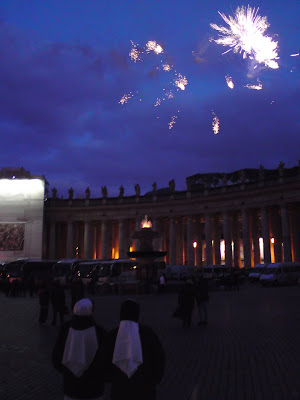
We managed to find someone who told us what it was about – it was for the sick, she said. Then fireworks started over the southern curve of columns. They went on and on, in inventive forms with multitudinous colours, and huge bangs that reverberated back and forwards across the square. They didn’t stop for a surprisingly long time. I don’t remember when I last saw such a display – it was a good deal more impressive than the several times I have been to the Lord Mayor’s fireworks in London.
One of our party, an American-Italian lexicographer, said her Catholic mother would be absolutely thrilled that she was blessed by the pope (a moment I managed to capture on my camera phone). It occurred to me then that the whole spectacle would most probably have depressed my mother severely. If she were thinking of something to do for the sick then she would start with prayer, but I doubt her next move would be a firework display which I just cannot believe could have come in under several tens of thousands of pounds. Visits would be more her style, helping to take people out, reading letters for blind friends, and talking to the lonely however difficult they may be – these are things which my mother, of whom I am proud, makes an effort to do. And I must say that the papal way did seem odd to me, when we’re so used to fireworks as celebrations – “there’s loads of sick people in the world – let’s make some noise!” Like the pharisees said, the money could have been spent on other things, and as a general rule I couldn't myself take part in the strange exuberances of Roman Catholicism. But it’s still quite joyful to stumble across them unexpectedly at dusk.
The white speck in the window on the top floor, second from the right, is the pope:

Here are some nuns watching fireworks:

Monday, 1 February 2010
Listening
I don't usually like to listen to audiobooks which I haven't already read. It's not only a snobbery thing, I also don't like to risk investing the listening time in something which I haven't already decided I like. But I've only read some of Gibbon's Decline and Fall -- I had a little six-volume Everyman set which is the only thing I regret getting rid of in my pre-Italy clear out, and I'd only read the first volume of that. I'm now listening to it on audiobook and it's fantastic. It helps that the narrator has a voice like Oliver Postgate, only instead of "Listen! I will tell you the tale of Noggin the Nog, as it was told in the days of old by the men of the Northlands", or "He was just an old saggy cloth cat, baggy and a bit loose at the seams, but Emily loved him", he says things like "Trained from his earliest youth in the exercise of arms, he set too small a value on the life of a citizen, chastised by military execution the slightest offences, and transferred the stern discipline of the camp into the civil administration of the laws", etc etc.
So far I am about 18 hours into the first of three unabridged volumes, each volume about 40 hours in length. Gibbon's beautiful rolling sentences were made to be read aloud by an Englishman of mature years with an understated wry inflection. The only problem with audiobooks is that it's harder to stop and reread something that's particularly good. So far the things that have made me want to go and find out more are 1) the way that Gibbon obviously loathed Galiennus but makes him sound really interesting 2) Zenobia seems pretty interesting too. Gibbon is very sniffy about her not committing suicide. (I hope there are good readable biographies of these people, but I expect not.)
The audiobook is from audible.co.uk, read by Bernard Mayes, who has also done an unabridged City of God, apparently, nearly 48 hours long. I don't think I could face that; you'd be about twenty hours in before he stopped telling you why it's not a good idea to worship Romulus.
Other good audiobooks on audible are: the comedy of Laura Solon; a brilliant unabridged Moonstone with each narrator done by a different actor; and anything with Sue Perkins in.
(Here is the famous Gibbon quote on the younger of the Gordians: "His manners were less pure, but his character was equally amiable with that of his father. Twenty-two acknowledged concubines, and a library of sixty-two thousand volumes, attested the variety of his inclinations, and from the productions which he left behind him, it appears that the former as well as the latter were designed for use rather than ostentation.")
So far I am about 18 hours into the first of three unabridged volumes, each volume about 40 hours in length. Gibbon's beautiful rolling sentences were made to be read aloud by an Englishman of mature years with an understated wry inflection. The only problem with audiobooks is that it's harder to stop and reread something that's particularly good. So far the things that have made me want to go and find out more are 1) the way that Gibbon obviously loathed Galiennus but makes him sound really interesting 2) Zenobia seems pretty interesting too. Gibbon is very sniffy about her not committing suicide. (I hope there are good readable biographies of these people, but I expect not.)
The audiobook is from audible.co.uk, read by Bernard Mayes, who has also done an unabridged City of God, apparently, nearly 48 hours long. I don't think I could face that; you'd be about twenty hours in before he stopped telling you why it's not a good idea to worship Romulus.
Other good audiobooks on audible are: the comedy of Laura Solon; a brilliant unabridged Moonstone with each narrator done by a different actor; and anything with Sue Perkins in.
(Here is the famous Gibbon quote on the younger of the Gordians: "His manners were less pure, but his character was equally amiable with that of his father. Twenty-two acknowledged concubines, and a library of sixty-two thousand volumes, attested the variety of his inclinations, and from the productions which he left behind him, it appears that the former as well as the latter were designed for use rather than ostentation.")
Subscribe to:
Posts (Atom)